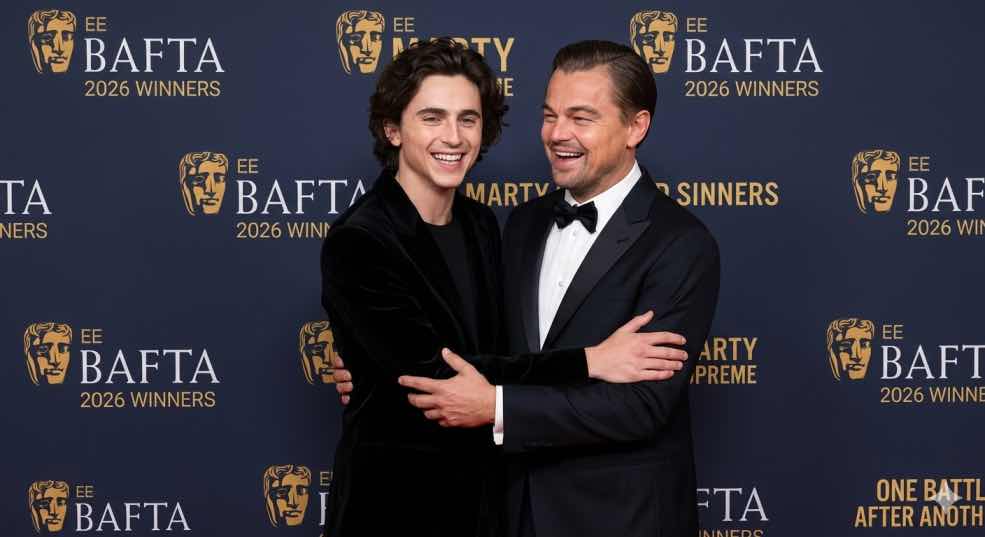
The 79th EE BAFTA Film Awards were held on February 22 at the Royal Festival Hall on London’s Southbank, and the first thing worth establishing is the atmosphere of the place. The Royal Festival Hall is not the Dolby Theatre. It is not designed for spectacle. It is a concert venue built in the early 1950s, all clean lines and warm wood, and it makes everyone who stands in it look like they belong to something slightly more civilised than the average awards ceremony. Alan Cumming, hosting for the first time following David Tennant’s two-year run, understood the room and played it right — sardonic, warm, effortlessly queer in the best sense of that word, at one point handing Timothée Chalamet a bag of British crisps with the energy of someone doing a bit that is also completely sincere.
One Battle After Another entered the night leading the nomination pack with 14 — just short of the all-time record of 16 set by Gandhi — and left with six wins: Best Film, Best Director, Best Adapted Screenplay, Best Cinematography, Best Editing, and Best Supporting Actor for Sean Penn. In accepting Best Director, Paul Thomas Anderson told the room that “anybody who says movies aren’t good anymore can piss right off, because this was a good fucking year.” Cumming, to his credit, let it hang in the air a moment before moving on. The BAFTA crowd appreciated it. He also paid tribute to Adam Somner, his UK-born producer and assistant director, who died of cancer during production — a moment that quieted the room in the way genuine grief quiets a room.
Sinners made history as BAFTA’s most-honoured film ever directed by a Black filmmaker, taking three awards: Best Original Screenplay for Ryan Coogler — making him the first Black winner of that particular prize in the British Academy’s history — Best Original Score for Ludwig Göransson, and Best Supporting Actress for Wunmi Mosaku, whose performance as Annie remains one of the year’s finest pieces of sustained screen acting. Marty Supreme, meanwhile, tied the record for the most BAFTA losses at a single ceremony, winning none of its eleven nominations. Josh Safdie was not present to receive this particular distinction.
Then came the evening’s genuine shock.
Robert Aramayo won Best Actor for his performance in I Swear, a fact-based British indie about Tourette syndrome campaigner John Davidson, beating out Ethan Hawke, Michael B. Jordan, Leonardo DiCaprio, and Timothée Chalamet. Aramayo, who earlier in the same evening had collected the EE Rising Star Award — meaning he left the Royal Festival Hall with two BAFTAs — looked genuinely stunned. “I absolutely cannot believe this,” he said. “Everyone in this category blows me away.” He said it like a man who had prepared a speech for losing, not for winning, and had to abandon the whole thing. The room, which had arguably expected DiCaprio or Chalamet to take it, responded with something warmer than consolation — genuine surprise shading into delight.
I Swear also brought the ceremony’s most delicate and significant ongoing situation. John Davidson — the real Tourette’s campaigner on whose life the film is based, and who was in attendance — has Coprolalia, a form of Tourette’s in which involuntary utterances include offensive language. Host Alan Cumming addressed the room twice during the evening to ask for understanding: “You may have noticed some strong language in the background. This can be part of how Tourette’s syndrome shows up for some people as the film explores that experience.”, The audience, which included Prince William and the Princess of Wales in her first BAFTA appearance since 2023, received these explanations with the grace they deserved. The subsequent BBC broadcast controversy — in which the broadcaster initially kept footage online that included an involuntary slur during a presentation by Black actors Michael B. Jordan and Delroy Lindo — belongs to a separate conversation about editorial responsibility, one that BAFTA and Warner Bros. made their displeasure about quickly and publicly known.
Jessie Buckley won Best Actress for Hamnet, a near-foregone conclusion that still landed with emotional weight because Buckley is one of those performers whose victories feel not like industry consensus but like a correction. Hamnet also took Outstanding British Film. Frankenstein swept the crafts — Costume Design, Makeup and Hair, Production Design — with Tamara Deverell’s production design in particular acknowledged as the year’s most visually ambitious work.
India’s Boong — a Manipuri-language film directed by Lakshmipriya Devi and produced by Farhan Akhtar — won Best Children’s and Family Film, the first-ever BAFTA win for an Indian production in that category. Sentimental Value won Best Film Not in the English Language. Akinola Davies Jr. won Outstanding Debut for My Father’s Shadow, a coming-of-age film set during Nigeria’s 1993 election crisis, and used the moment to honour his immigrant parents and the Cannes distinction of being the first Nigerian film selected for the main competition. “Representing Nigeria is a real badge of honour,” he told Euronews after the ceremony. “Our stories are incredibly universal.”
The BAFTA Fellowship was awarded to Donna Langley, NBCUniversal Entertainment chair and the first British woman to run a major Hollywood studio, who told the audience that “decency is a superpower” and that the future of the industry is “not something that happens to us — it’s something we shape.” The Outstanding British Contribution to Cinema Award went to Clare Binns of Picturehouse Cinemas, who advised filmmakers to keep their speeches short. The filmmakers present took notes.
The 2026 BAFTA Film Awards complete major winners: Best Film — One Battle After Another | Outstanding British Film — Hamnet | Best Director — Paul Thomas Anderson | Best Leading Actor — Robert Aramayo (I Swear) | Best Leading Actress — Jessie Buckley (Hamnet) | Best Supporting Actor — Sean Penn (One Battle After Another) | Best Supporting Actress — Wunmi Mosaku (Sinners) | Best Original Screenplay — Ryan Coogler (Sinners) | Best Adapted Screenplay — Paul Thomas Anderson | Best Cinematography — Michael Bauman (One Battle After Another) | Best Film Not in the English Language — Sentimental Value | EE Rising Star — Robert Aramayo | BAFTA Fellowship — Donna Langley