
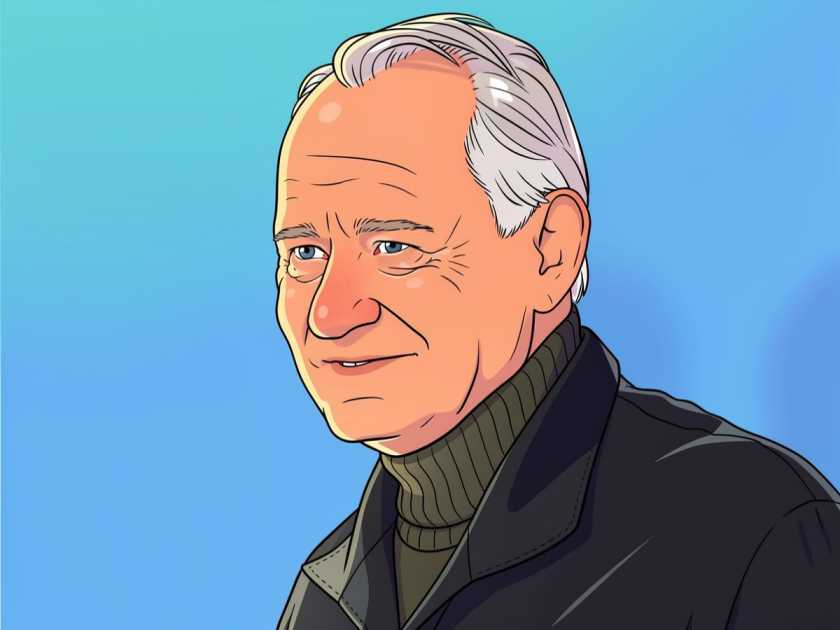


He became the first Best Supporting Actor nominee from an international film in 97 years of the Academy Awards. At 74, after 54 years in film, he finally got his first nomination. Sean Penn took the Oscar. The history remains.
The 98th Academy Award nominations were announced on January 22, 2026. Sentimental Value received nine of them — an all-time record for a Norwegian film. But the nomination that generated the most sustained industry conversation was a quieter, more specific piece of history: Stellan Skarsgård received his first-ever Oscar nomination.
He was 74 years old. He had been acting professionally since he was a teenager. He had appeared in over 200 productions across five decades, in Swedish, English, Norwegian, and Danish. He had worked with Lars von Trier, Steven Spielberg, Ridley Scott, and Christopher Nolan. He played Boris Shcherbina in Chernobyl, one of the finest performances in prestige television history. He played Luthen Rael in Andor for four years and was widely considered the best thing in it.
And before Sentimental Value, he had never once been nominated for an Academy Award.
The nomination was doubly historic. In the 97 years of Academy Awards, the Best Supporting Actor category had never gone to an actor from an international film. Skarsgård broke that mold with his nomination as Gustav Borg. Only one Swedish male actor had previously been nominated for an Oscar at all — Max von Sydow, who received nominations for Pelle the Conqueror in 1987 and Best Supporting Actor in a subsequent film.
Skarsgård plays Gustav Borg — a celebrated film director, estranged father, man of enormous charm and consistent emotional unavailability — who returns to Oslo after his ex-wife’s death with a new screenplay and old unresolved guilt. It is, by his own account, the best role he has ever been given. “You are allowed to say it’s one of the best roles of my career — if not the best,” he told Variety. “It’s not only the role as written on the page. It became what it became through Joachim’s way of letting me do my job as fully as possible.”
The role carried personal weight that deepened the performance beyond what was on the page. As a father of eight children, Skarsgård has spoken openly about the competing demands of artistic ambition and family presence. He described the moment his son Gustav told him after seeing the film, “Do you recognise yourself?” — and Skarsgård realising, after a pause, that he did.
What Happened on Oscar Night
On March 15, 2026, Skarsgård attended the ceremony at the Dolby Theatre. He was in a competitive category — up against Sean Penn and Benicio Del Toro for One Battle After Another, Jacob Elordi for Frankenstein, and Delroy Lindo for Sinners. All five performances were legitimate contenders. Sean Penn won, his third career Oscar, for his role as the white supremacist Colonel Steven J. Lockjaw in One Battle After Another. Penn was not at the ceremony to collect it.
Skarsgård did not win. He has spoken about this with characteristic equanimity in the weeks since — the same quality of acceptance that runs through Gustav Borg’s character and, it seems, through Skarsgård himself. You get the sense that a man who spent 54 years making extraordinary work without a single nomination is not devastated to have received one and lost.
What matters is what the nomination represented and what it will represent going forward.
Why Stellan Skarsgård‘s History Stands Regardless
Awards outcomes are transient. The historical record is not. Stellan Skarsgård is permanently the first actor to receive a Best Supporting Actor nomination from an international film in the Academy’s history. In the years prior to this nomination, the other three acting categories had gone to international productions — Fernanda Torres for I’m Still Here, Antonio Banderas for Pain and Glory, Marina de Tavira for Roma — but this particular category had remained closed for 97 years. Skarsgård opened it.
The fact that Sentimental Value won Best International Feature Film — Norway’s first ever Oscar — means the film itself did not leave the Dolby Theatre empty-handed. The country got its win. Trier got his Oscar. Skarsgård got his nomination, his Golden Globe win, his six European Film Awards wins alongside his cast. It is by any measure one of the most decorated awards seasons in Scandinavian cinema history.
The Larger Point About How Long Things Take
There is something worth sitting with in the fact that it took Skarsgård until age 74 to receive his first nomination. Not because the Academy should be blamed — the voting membership has expanded significantly in recent years and the international film presence in Oscar nominations is genuinely broader than it was a decade ago. But because it is a reminder of how long serious work can go unrecognised by the institutions that are supposed to recognise it.
Skarsgård told Variety that what he loves most about acting, after 50 years, is being on set — the collaborative creation, the energy exchange between performers. “I’m not really a monologue actor. I’m a dialogue actor. I take my energy from the other actors and give my energy back to them.” A man who has been doing this since the early 1970s, who survived a stroke in 2022 that affected his memory and language and adapted his working methods to continue — and then delivered what he himself considers his finest performance — deserves more than one nomination. He deserves a proper reckoning with the full body of work.
The Oscar would have been a fine addition. The nomination, and everything it confirmed about the quality of Sentimental Value and the stature of Skarsgård’s career, is not nothing.
It is, in fact, quite a lot.
Sentimental Value is streaming now on MUBI India.
Award results confirmed via the Academy of Motion Picture Arts and Sciences official records. Ceremony held March 15, 2026, Dolby Theatre, Hollywood. Career information sourced from the Swedish Film Institute, Gold Derby, and Variety’s February 2026 interview with Stellan Skarsgård.
Published: March 26, 2026