

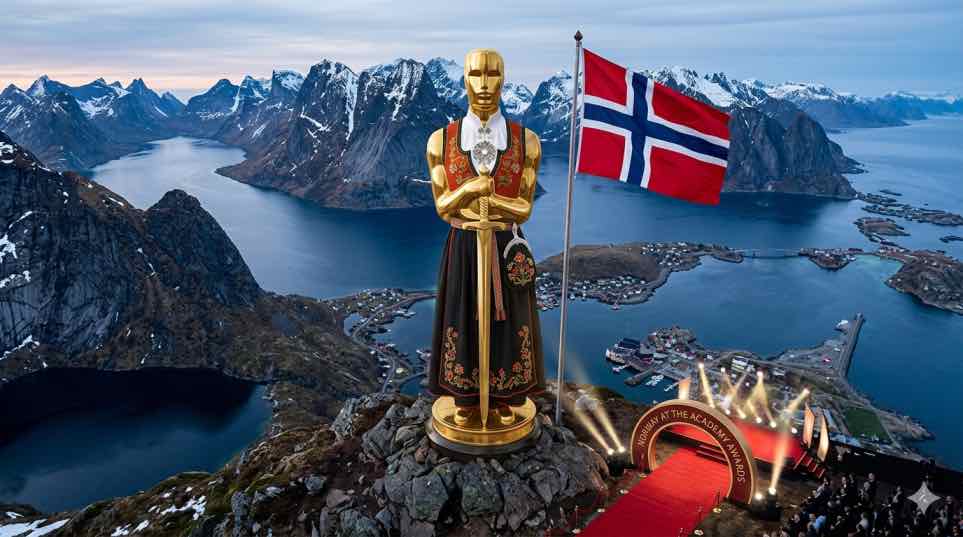
Joachim Trier’s Sentimental Value made history on March 15, 2026. Here’s the full Norwegian cinema Oscar history and why this win was decades in the making.
The complete Norwegian cinema Oscar history is, until very recently, a story of honourable near-misses. Seven nominations across seven decades in the Best International Feature Film category, and no win — until Joachim Trier walked to the podium at the Dolby Theatre on March 15, 2026, said “I’m just a film nerd from Norway,” and accepted the Oscar for Sentimental Value. Norway had its first Academy Award for an international feature, and Scandinavian cinema had a new reference point.
To understand why this moment carries the weight it does, you need to understand what Norwegian film has been quietly building toward for the better part of four decades.
Norwegian Cinema Before the Oscars: The Early Decades
The Norwegian cinema Oscar history is older than most people realise. Thor Heyerdahl’s documentary Kon-Tiki (1951), a chronicle of his famous Pacific raft journey, won Norway’s first Academy Award for Best Documentary in 1952. For decades after, it remained the country’s only Oscar of any kind.
The Norwegian film industry itself developed along unusual lines. Norwegian cinema was of a smaller scale than neighbouring Sweden and Denmark, but a distinct tradition emerged, with literary adaptations and romances particularly popular. The industry fell into decline in the 1980s, with Hollywood dominating the market.
The contrast with Scandinavia’s two larger film nations was stark. Sweden had Ingmar Bergman — arguably the most influential film director of the 20th century — whose presence cast a long shadow over the entire region. Denmark had Lars von Trier and Thomas Vinterberg and the Dogme 95 movement, which reshaped European filmmaking in the 1990s. Finland had Aki Kaurismäki. Norway had excellent filmmakers and significantly less international recognition.
As producer Yngve Sæther of Oslo-based Motlys puts it, Norway was always “the little brother” to the grown-up movie nations: “When I started, there wasn’t even a film school here. I had to go to Sweden to study.”
The Infrastructure That Made the Norwegian Cinema Renaissance Possible
The Norwegian cinema renaissance did not happen by accident. It was the product of deliberate, sustained public investment made possible by Norway’s oil wealth and a political consensus that cultural production was worth funding seriously.
The establishment of the Norwegian Film Fund in 2001 gave domestic productions a chance to compete with Hollywood, and the Norwegian Film School, which opened in 1994, played a significant role in the rejuvenation of Norwegian cinema.
Successive Norwegian governments funnelled oil wealth into culture, slowly building a system designed to nurture both artistic ambition and commercial viability. Producers are actively encouraged to seek international partners, with incentives tied to global sales performance — encouraging Norwegian filmmakers to look outside Norway from the start.
The result was a generation of filmmakers trained to the highest international standards, funded seriously, and incentivised to think globally. Sentimental Value, with its co-production spanning Norway, France, Denmark, Germany, Sweden, and the UK, is a direct product of this system. For a deeper look at how the film was made, read our full Sentimental Value page.
Norwegian Cinema’s Seven Nominations Before the Win
The Norwegian cinema Oscar history in the Best International Feature Film category is a story of consistent near-misses. Seven nominations spread across decades, in a competitive category that tests the limits of what international cinema can achieve at the Academy level.
The nominations that preceded Sentimental Value include Ni Liv (1957), Pathfinder (1987), The Other Side of Sunday(1996), Elling (2001), and Kon-Tiki (2012). Each confirmed that Norwegian cinema was producing internationally competitive work. None produced a win.
As of 2026, Norway has been nominated seven times in the category and won once — for Sentimental Value.
The closest modern precedent was Trier’s own The Worst Person in the World (2021), which received two Oscar nominations — Best Actress for Renate Reinsve and Best Original Screenplay — introducing Norwegian cinema to a generation of viewers who had not previously sought it out.
Sentimental Value became the first Norwegian film ever nominated for Best Picture itself — the most prestigious Oscar category — alongside its nomination for Best International Feature Film. That dual placement in the main and international categories simultaneously was a statement about how seriously the Academy’s expanded, internationally diverse membership was taking Norwegian film.
Joachim Trier: The Director Who Delivered Norway’s First Oscar
Understanding the Norwegian cinema Oscar history means understanding Joachim Trier, because he is the filmmaker most responsible for placing Norwegian cinema at the centre of the international conversation.
Trier came from a filmmaking family. His grandfather Erik Løchen made Norway’s first experimental film in 1960, selected for Cannes that same year. He trained in Denmark and the UK before returning to Norway to make Reprise(2006), which announced someone with an unusually refined cinematic intelligence. Oslo, August 31st (2011) established him internationally as a filmmaker of the first rank. The Worst Person in the World made him a household name in serious film circles globally. Sentimental Value completed the arc — a film that drew on his own family’s relationship with Norwegian cinema while simultaneously extending that history by winning it.
Trier has spoken about this generational dimension openly: “My grandfather was a director, my parents worked in cinema. In families many things are passed on without being said. The beauty of cinema is its ability to make those silent spaces visible.”
For the full picture of Trier’s approach to filmmaking on this project, read our complete Sentimental Value review and analysis.
What Norway’s First Oscar Means for Scandinavian Cinema
Norwegian cinema is going through what observers are calling a creative and commercial golden age, with a steady stream of internationally recognised talents coming out of a nation of just 5.6 million people.
Norwegian Film Institute CEO Kjersti Mo, who attended the ceremony alongside the Sentimental Value team, was direct: “This is a historic moment for Norwegian cinema. We have long been the underdogs in Scandinavian cinema, compared to Sweden and Denmark, so this means the world to us.”
The Academy Award functions as a signal to distributors, festival programmers, and international audiences that Norwegian cinema deserves serious sustained attention. It creates a market for the films that follow, in the same way that Parasite‘s four-Oscar sweep in 2020 catalysed global interest in Korean cinema. For further reading on how international films succeed at the Oscars, the Norwegian Film Institute’s official coverage of Sentimental Value‘s campaign is worth reading in full.
The most important consequence of Norway’s first Oscar in this category may be invisible: the filmmaker who is 25 today in Oslo, deciding whether to commit to a career in cinema, will grow up in a country that has produced an Oscar-winning film. That calibration changes what feels possible. That is how national cinema traditions compound.
Where to Watch the Film That Made Norwegian Cinema History
Sentimental Value is available now on MUBI India — streaming exclusively for Indian audiences. If you want to understand what Norwegian cinema history looks like at its current peak, this is where to start.
Norwegian film history sourced from the Norwegian Film Institute and Wikipedia’s list of Norwegian Oscar submissions. Academy Award data confirmed via the Academy of Motion Picture Arts and Sciences.
Published: March 18, 2026 | Updated: March 26, 2026 | By Abhishek, MovieRamen Founder and Editor.