


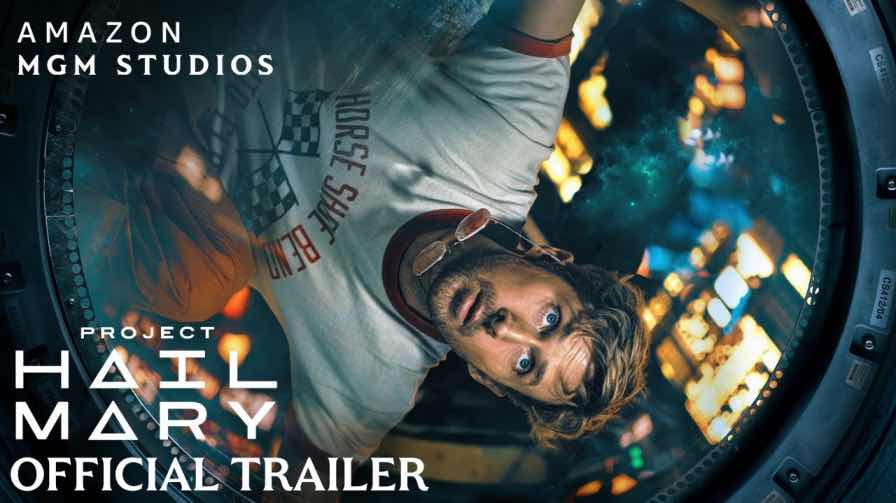
It is not just a hit. It is a statement about original storytelling, about Amazon MGM’s ambitions, and about what theatrical audiences still want in 2026.
The Project Hail Mary box office story is already one of the most discussed in Hollywood this year, and it deserves more analysis than a number and a ranking. Because what is happening with Ryan Gosling’s sci-fi epic over its first two weekends is not just a film performing well. It is a set of signals about the state of the theatrical industry in 2026 that every studio executive, streaming platform CEO, and serious cinema observer should be reading carefully.
Let’s start with the numbers, then work out what they actually mean.
Project Hail Mary’s Box Office
Project Hail Mary was released on March 20, 2026, by Amazon MGM Studios. It had its world premiere in London on March 9. As of March 27, the film had grossed $164 million in the United States and Canada and $137 million in other territories for a worldwide total of $301 million.
The space odyssey grossed $300.8 million globally after earning another $54.1 million from 86 markets in its second weekend, easily topping the $276 million worldwide gross of 2023’s Creed III, which had previously been Amazon MGM’s highest-grossing film.
The film holds a stellar 95% rating on Rotten Tomatoes and earned an “A” grade on CinemaScore exit polls. Critical enthusiasm and audience enthusiasm are aligned — a combination that is rarer than the industry sometimes pretends.
Why This is Significant: Original Non-Franchise Film
This is the part of the Project Hail Mary box office analysis that matters most to me and should matter most to anyone who cares about cinema’s long-term health.
Project Hail Mary follows Oppenheimer as only the second non-sequel or non-franchise film in the past decade to open to $80 million or more domestically. Think about what that means. Ten years of theatrical releases. Two films without a Roman numeral in the title, without an IP brand, without a superhero suit or a cinematic universe attached to it — and they both found massive audiences.
Project Hail Mary is based on a bestselling science fiction novel by Andy Weir, whose book The Martian was also adapted into a successful film a decade ago. His next novel is almost certain to spark a bidding war for the movie rights. This is what franchise-building actually looks like when done right — not retrofitting a brand, but creating one from genuine creative material.
What This Means for Amazon MGM
2026 is Amazon MGM’s first year with a full theatrical slate — 13 films scheduled — since acquiring MGM for $8 billion in 2022. The company’s foray into theatrical had been rocky, with high-profile disappointments including January’s Melania documentary ($16M against a $40M budget) and February’s Crime 101 ($65M against a $90M budget).
Amazon’s head of film Courtenay Valenti told The New York Times that the big opening weekend validated the company’s strategy of making “big, bold entertaining commercial films.” That is the quote of someone who needed a win and got one.
There was real pressure on Project Hail Mary to change the narrative around Amazon MGM’s movie efforts. It has done that, and then some.
The Hold Percentage: The Most Important Number
When analysts discuss box office performance, the opening weekend gets the headlines. The hold percentage is what tells you whether a film is a genuine hit or a front-loaded disappointment.
Project Hail Mary‘s -32% second-weekend drop is meaningfully better than Dune: Part Two (-44%), Oppenheimer (-43%), and even Sinners, which had an extraordinary -4.8% hold but a lower second-weekend gross in absolute terms.
A -32% hold on $54.5M suggests two things simultaneously: the audience is returning for repeat viewings (a reliable sign of genuine cultural resonance), and the film is still finding new viewers who were not in cinemas on opening weekend. Both of those dynamics sustain a long theatrical run. Easter weekend arrives next, with schools on holiday and more family-accessible viewing windows opening up.
The Imax Factor
Imax’s foreign box office on Project Hail Mary was $11.2M in the opening weekend. In China, the Imax network was a staggering 34% of the total opening and set the record for the biggest debut of an original sci-fi title in the large format. Other notable Imax indexing markets include UK (16.4%), Japan (29%), Hong Kong (33%), South Korea (25%), and Mexico (16%).
These numbers confirm something Imax’s CEO Rich Gelfond articulated after the opening: space films and Imax have a natural relationship that dates back to documentary programming. A film that is genuinely spectacular in space — and Project Hail Mary is, by all critical accounts — will always find a premium format audience. The lesson for studios: when the material justifies the premium, audiences pay for it.
What Comes Next for the Film
The end game for domestic is projected at $265M, but with the Easter holiday weekend ahead with K-12 schools on break at 71% on Friday and colleges at 34% – the film feels like it could shoot past the moon. Globally, a worldwide total approaching $500M is the threshold Variety estimates the film needs to break even theatrically. At $301M after ten days, with Easter ahead and strong international holds, that target is very much within reach.
The bigger question is whether The Super Mario Galaxy Movie — arriving April 1 — co-exists with Project Hail Mary or cannibalises its audience. Super Mario‘s audience skews younger and family-oriented; Hail Mary‘s skews older and more cinephile-leaning. There is meaningful overlap but not complete overlap. Both films could do significant business simultaneously if the overall market holds.
For now, Project Hail Mary‘s box office performance stands as 2026’s clearest proof that the theatrical industry’s recovery is real — and that original storytelling still has a seat at the table.