
A “oner” is a single continuous shot with no visible cuts — a sequence, a scene, or in rare cases an entire film, captured in one unbroken take. You’ve seen them even if you didn’t know the name. The opening of Goodfellas following Henry Hill through the Copacabana. The Omaha Beach sequence in Saving Private Ryan. The hospital corridor fight in 1917.
The term sounds simple. The execution is anything but.
Why directors use them
A oner does something cuts cannot: it eliminates the director’s ability to hide. In conventional filmmaking, editing is a safety net. A performance can be assembled from twelve different takes; a scene can be restructured in post-production; an actor’s bad moment can simply be removed. In a oner, every second has to work, because every second is visible and in sequence. The result, when it succeeds, is a quality of immersion that edited sequences rarely achieve — the sense that you are present in an event rather than watching a curated version of it.
Directors also use oners to manipulate the audience’s perception of time. A long unbroken take forces the viewer to experience duration the way the characters do. This is why Adolescence — which filmed each of its four episodes as a single continuous take — creates such unbearable tension. You cannot cut away from the discomfort, because the camera never does.
Why they’re so hard
The logistical challenges are enormous. Every department — camera, lighting, sound, costume, props — has to be choreographed perfectly for the entire duration. If the camera operator stumbles on take eight minute seven, you start again from the beginning. Actors have to hold their performances across the entire length without a reset. Sets have to be designed around a camera path that may span multiple rooms, floors, and locations.
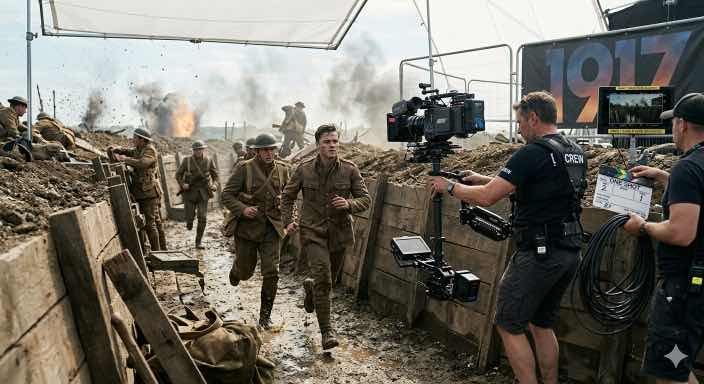
1917 is the most technically ambitious recent example. Director Sam Mendes and cinematographer Roger Deakins designed every scene so the camera could flow continuously through a World War One landscape across a 119-minute film — using hidden cuts, environmental transitions, and an extraordinary amount of pre-production planning to create the illusion of one unbroken shot. It isn’t actually one take, but the seams are invisible.
The Studio on Apple TV+ devoted an entire episode to satirising this — a director trying to shoot a oner while Seth Rogen’s character keeps accidentally ruining it — and Rogen and Goldberg shot that episode as a oner. The joke is also a demonstration.
The difference between a oner and a long take
Technically, a “long take” simply refers to any shot held longer than average. A oner specifically implies the shot is constituting a complete scene or sequence rather than just lingering. All oners are long takes. Not all long takes are oners.
The skill is not in the length. The skill is in making the length feel necessary — making you forget the camera is even there.